AI Powered Conversational and Creative Agent Studio
Client
Indigenius
Industry
AI
Year
2021 - 2025
Role
UX & Implementation
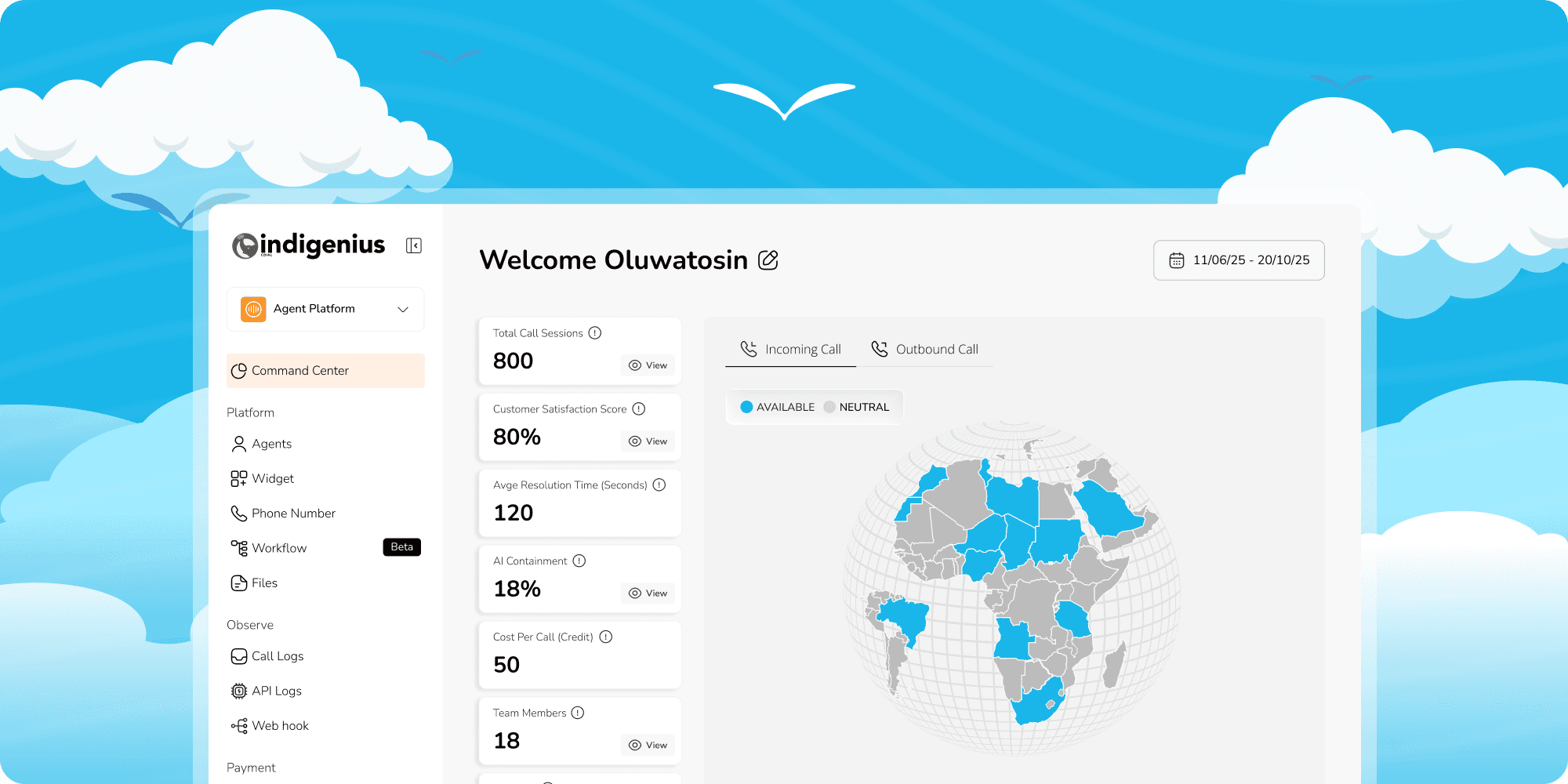
The Brand
Indigenius is a multi-channel AI agent Voice platform that enables businesses to automate workflows across email, chat, SMS, and voice channels. As the lead product designer, I was responsible for creating an intuitive interface that made complex AI automation accessible to non-technical users.
The Product
An advancing African Language Models Designed to support the development of African-focused voice AI, making digital services more accessible through natural conversations across multiple regional dialects.
The challenge

Problem
AI tools were not designed for Africans, languages, or contextual realities. Existing agents struggled with linguistic diversity, cultural nuance, and low-quality localized training data. Creating inaccurate responses or limiting adoption across key African markets.
Approach
My work focused on translating research insights into interaction models for agent creation, onboarding, task execution and embedding feedback loops that continuously refined model interactions based on user behaviour and support signals.
Impact
Measurable improvement in user satisfaction, with platform ratings increasing to 4.0/5. Simplified onboarding and improved task architecture reduced user confusion and led to a noticeable drop in support requests within six months.
Key Insights
Issues that made the adoption process slow and inconvenient.
First, 78% of users found existing automation platforms too technical and difficult to set up.
Second, Teams managed 4-7 different tools for email, chat, SMS, and voice support.
Third, Support teams spent 22.5 hours/weekly on repetitive, automatable tasks.
Fourth, 64% of customer conversations lost context when switching channels.

Conversation Agent
The Conversational Agent system is designed as a modular intelligence layer that enables users to create and deploy agents tailored to specific goals. Each agent can be configured with contextual awareness, allowing it to understand ongoing tasks, maintain state, and adapt responses based on user intent and previous interactions.
Beyond conversation, agents are extensible through integrations with both widgets and workflows. This enables them to trigger structured actions such as data retrieval, content generation, or multi-step processes, all from within a single conversational interface. By linking agents to these execution layers, the system moves beyond chat into task orchestration, supporting multiple actions while preserving coherence, continuity, and task relevance across interactions.


Creative Agent
The Creative Agent section is where the system shifts from static tools into something closer to a production studio. Users can generate and adapt content across voice, language, and media formats without switching tools or workflows.
At its core, it supports voice selection across a range of available characters and tones, including African and global languages to ensure cultural and linguistic relevance. Users can generate audio through text-to-speech, convert spoken input using speech recognition, and apply dubbing to localize or reframe existing Video/audio content. Each voice option is designed to maintain natural cadence while adapting to different emotional and contextual needs.
Beyond audio, the agent extends into multimodal creation. Users can generate video content directly from prompts, combining narration, visuals, and timing into a single output flow. This makes it possible to move from concept to finished media in one continuous system rather than fragmented tools.
The result is a unified creative layer where voice, language, and video are treated as interchangeable building blocks rather than separate processes.


Key Learnings & Reflections
Conversational AI focused on improving natural dialogue, intent handling, and reducing friction in task completion through structured onboarding and feedback loops. Creative AI explored generative expression, evaluation quality, and user control in ideation workflows. Together, both highlighted the importance of grounding intelligence in user context, iteration, and measurable product impact.

National Payment Experience for Millions of Nigerians
Finance
B2B/b2C
Website

Collective Intelligence for building model accuracy.
COLLECTIVE INTELLEGENCE
Dataset
Mobile
Explore my journey and learn what sets me apart in crafting impactful digital experiences.
About Me